


📞 CALL OR TEXT:
213-999-8966

By Herbert Zhu | A Colored Mind Wedding Films

The Ebell of Los Angeles is one of those wedding venues that immediately feels different when you walk inside. Instead of a modern ballroom built specifically for events, you are surrounded by historic architecture, warm interiors, dark wood, tall windows, vintage details, and rooms that each have their own personality.
I had the opportunity to film Emalee and Matthew’s wedding at The Ebell, and what stayed with me was how much visual variety we could create without ever leaving the property.
We moved from quiet getting-ready moments and beautiful natural light to portraits around the historic exterior, a dramatic indoor ceremony, formal interiors, dinner, speeches, and a completely different atmosphere once the reception and dancing began.
For me as a Los Angeles wedding videographer, that variety is what makes The Ebell such an interesting place to film. The Ebell organization was founded in 1894, while its historic Mid-Wilshire campus was built in 1927 and designed by architect Sumner Hunt. The Renaissance-inspired property includes several distinctive indoor and outdoor spaces, each with its own architectural character.
A venue can look beautiful in photographs, but a wedding film shows you something different. You see how people actually move through the space, hear the vows and speeches, watch the light change throughout the day and experience the atmosphere as the celebration moves from ceremony to reception.
I’ve now had the opportunity to film multiple weddings at The Ebell of Los Angeles. Emalee and Matthew’s wedding and Emily and Irving’s wedding took place at the same historic venue, but each celebration had its own visual style and energy. Together, these films give a much better sense of what an actual Ebell of Los Angeles wedding can look and feel like.
Emalee and Matthew’s wedding film gives you another perspective on what an actual wedding at The Ebell feels like. Their wedding moved between the bright exterior architecture, darker historic interiors, a dramatic ceremony, portraits throughout the property, and a warmer reception atmosphere as the evening continued.
That contrast is something I especially enjoy about filming weddings at The Ebell. A wedding here doesn’t have to maintain one visual style from beginning to end. The changing rooms, architecture, natural light, and evening atmosphere create a visual progression that gives me much more to work with when building a wedding film.
"Not to brag, but watching our wedding videos felt like watching the trailer of a highly-anticipated, Oscar-winning drama. Herbert and his team did such an amazing job putting together all of our big day's biggest moments and the energy, aesthetic and love was present from start to finish. He was very quick to make little changes we asked for and he used all of the songs we requested in the extended version in addition to his own selection which fit the vibe perfectly.

In addition, Herbert got all the shots we wanted to have on film to watch in the future...and that was a tall order considering we had over 200 people and had a lot of different scenery to work with at our venue.

Southern California weddings are not cheap, and quality vendors cost a pretty penny. A Colored Mind Films had the most competitive pricing and provided more perks to their packages than other vendors. Highly recommend them if you want you to blow everyone's minds on Instagram...and have something to re-watch and cry tears of joy to with your partner whenever you're feeling nostalgic." - Emalee Lien
Emily and Irving’s wedding shows a different side of The Ebell of Los Angeles, from their indoor ceremony and portraits to an energetic reception with a live band. I also captured the venue from the air during both the daytime and nighttime, which shows how dramatically The Ebell changes once the sun goes down and the celebration moves into the evening.
Their wedding film begins with some of the reception energy before moving back through the story of the day. The live music, speeches, architecture, changing light, and nighttime atmosphere all gave me different elements to work with while creating a film that still feels connected to The Ebell’s historic character.

What I enjoyed most about filming at The Ebell was that I never felt limited to one visual style. Some wedding venues have one beautiful ceremony location but very little variety once you begin looking for portraits or cinematic establishing shots. The Ebell is different.
For couples who love classic Los Angeles architecture, The Ebell has a personality that is difficult to reproduce at a newly built wedding venue. It doesn’t feel like a blank ballroom waiting to be transformed. There are elegant rooms, darker historic interiors, tall windows, hallways, architectural details, stairways, and a beautiful exterior that gives the couple a completely different look without having to leave the property. For a completely different Los Angeles look, you can also see how I approached a Millwick Downtown LA wedding, where industrial textures, greenery, and the surrounding Arts District streets created a more urban visual atmosphere on film.
Moving between these spaces allowed me to give different parts of Emalee and Matthew’s wedding their own feeling while keeping the entire film visually connected. The carved details, tall windows, historic rooms, exterior architecture, stairways, and darker interior tones are already part of the visual experience. Because of that, weddings here can work beautifully with classic, romantic, editorial, Old Hollywood, vintage-inspired, and modern-elegant styles.
The venue also has a sense of history that you don’t have to manufacture with decorations. The building itself already gives the wedding character. From a filmmaker’s perspective, that is extremely valuable.
Personally, I think The Ebell looks strongest when couples allow the existing architecture to remain part of the design instead of trying to cover it with too much décor. There is already so much character in the building. Sometimes simple and intentional styling actually allows the venue to look more impressive on film. If you love this kind of historic architecture, you can also see how I approached filming an Ebell Club Long Beach wedding where the setting creates a very different visual atmosphere.
I don’t need to constantly create something that isn’t there. Instead, I can pay attention to the architecture, existing light, movement, and most importantly, the people and emotions happening inside the space.

Getting-ready footage is often treated as something that simply happens before the ceremony, but I see it as the beginning of the wedding story. At The Ebell, the historic interiors give these quieter moments much more visual character.
This is where I like to capture the details that will become important later in the film: the dress, jewelry, invitations, family interactions, friends helping each other get ready, handwritten notes, and those few quiet minutes before everything starts moving quickly. I am also watching what the light is doing.
Windows, doorways, mirrors, darker corners, and the architecture around the couple can all help create images that feel natural without turning the getting-ready portion of the day into a staged photo shoot. One advantage of filming in a venue with this much character is that even simple moments can look intentional without needing to manufacture very much.
And those quiet moments are important because once the ceremony begins, the pace of the wedding changes completely.

Emalee and Matthew had their ceremony indoors in one of The Ebell’s large historic rooms. This was actually one of the most visually distinctive parts of their wedding.
At the front of the ceremony space are large windows behind the couple, which create a beautiful background but also create a very real technical challenge for wedding photography and videography: backlight.
When strong daylight is coming through large windows behind the couple while the room itself is relatively dark, the camera is dealing with two very different exposure levels at the same time. If you expose only for the windows, the couple can become too dark. If you expose too aggressively for the couple, the windows can become extremely bright and lose detail.
Fortunately, The Ebell has a light positioned from the second-floor level and pointing down toward the ceremony area. That light helped illuminate Emalee, Matthew, and the officiant. However, the bridesmaids and groomsmen standing on the two sides did not receive the same amount of light.
That was something I needed to solve. For their ceremony, I brought in two of my own video lights and positioned one on each side of the ceremony space. One helped illuminate the bridesmaids, while the other helped illuminate the groomsmen.
The goal wasn’t to make the room suddenly look bright. I actually wanted to preserve the darker, dramatic atmosphere of The Ebell. The additional lighting was there to balance the wedding party enough that the bridesmaids and groomsmen wouldn’t disappear into the darker sides of the room while the couple remained illuminated in the center.
This is one of those details couples probably never think about when they walk through a venue. You see a beautiful room and enormous windows. As a filmmaker, I’m also seeing the direction of the light, the difference in exposure between the background and the people, where the wedding party will stand, and what I need to do so everyone still looks natural on camera.
And when it is done correctly, you shouldn’t really notice the lighting setup. You should simply watch the ceremony and feel like the room looked beautiful.

Dark wedding venues are not automatically bad for video. In fact, I often prefer a space with character and mood over a room that is bright but visually flat. The important part is understanding how to work with it.
At The Ebell, I wouldn’t want to flood the ceremony room with harsh lighting and destroy the atmosphere the couple chose. Instead, I want to preserve the darker interior, protect the bright windows as much as possible, properly expose the couple, and selectively add light where it is actually needed.
For Emalee and Matthew’s ceremony, that meant using the venue’s existing light for the center ceremony area while adding my own lights to the two sides. The result still feels like The Ebell. It just photographs and films more evenly.
This is one reason I believe having experience at a venue can be useful. The next time I walk into this ceremony space, I already understand where the backlight comes from, how the existing ceremony light behaves, and which areas may need additional illumination. That means I can spend less time figuring out the room and more time paying attention to the wedding.

You don’t necessarily need to leave The Ebell to create variety in your wedding portraits. Some of my favorite locations are not complicated setups at all. They are combinations of architecture, natural window light, symmetry, exterior lines, and simple movement between the couple.
For Emalee and Matthew, the historic exterior also gave us a completely different look from the darker indoor footage. The brighter exterior walls, entrance, steps, windows, and architectural lines allowed the wedding film to visually breathe before moving back into the moodier interiors.
But one particular shot I remember from filming here was something completely different.

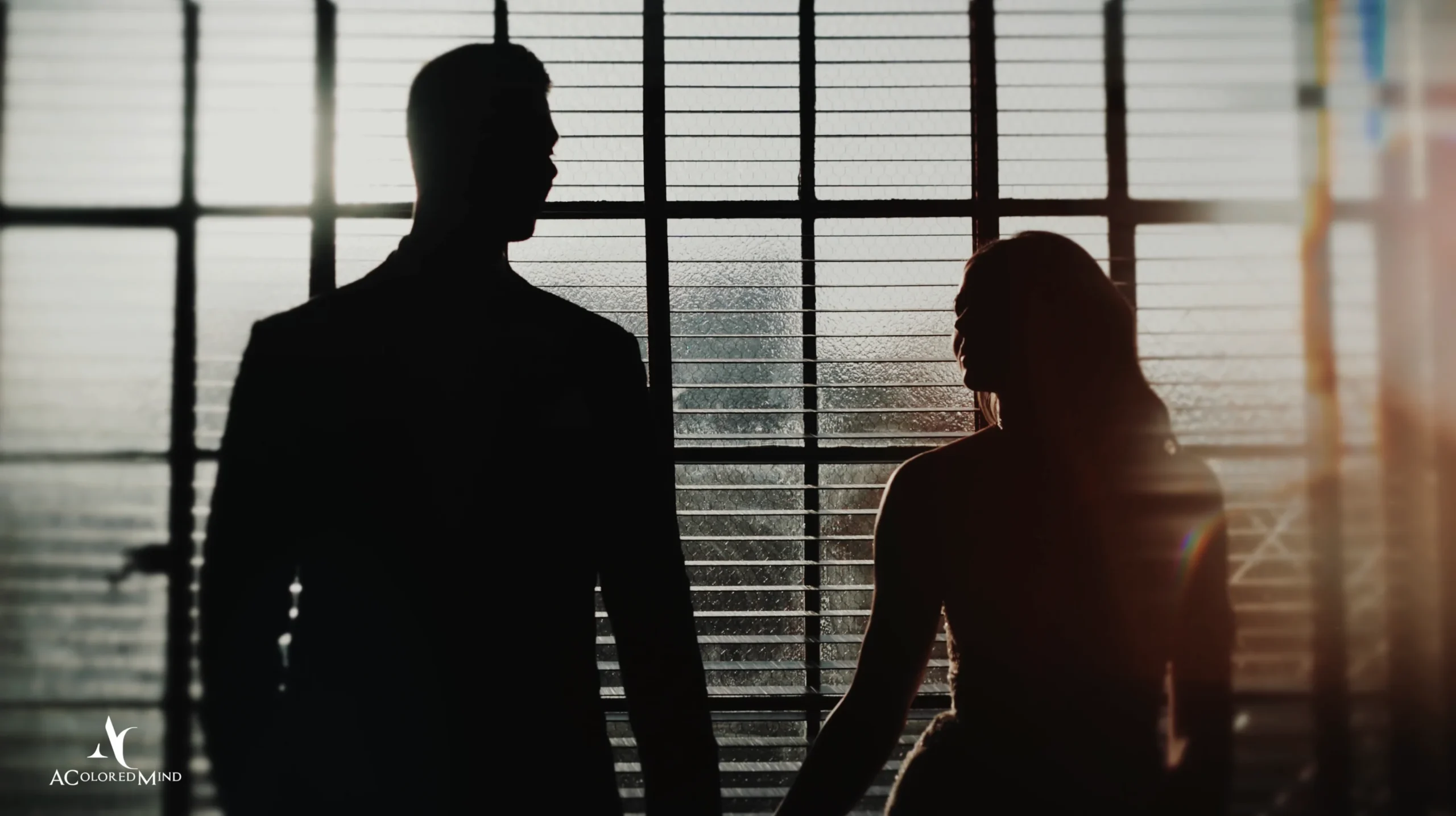
On the third floor, I found an opportunity to create a silhouette of Emalee and Matthew in front of one of the windows. During their wedding, I filmed it in the late afternoon.
The light outside was significantly brighter than the interior, which normally creates the same kind of exposure challenge I described with the ceremony. But for this shot, instead of fighting the backlight, I used it intentionally.
I exposed for the brighter window and allowed Emalee and Matthew to fall into silhouette. That turned what could have been a lighting problem into one of the more cinematic images from the day.
I really like using a venue this way. Not every portrait needs to clearly show both faces. Sometimes the shape of the couple, the window, the architecture, and the contrast between light and shadow can say enough.
I would never promise that the identical light will happen at exactly the same clock time for every Ebell wedding because the sun changes throughout the year. But this is exactly why venue experience can be useful. Once I know where certain light can happen, I can watch for the right opportunity instead of discovering the location for the first time on the wedding day.

When I film couple portraits at The Ebell, I begin by studying the architecture before deciding how the couple should move. I look for stairways, windows, hallways, exterior lines, shadows and natural light that can give the frame direction. Once I find a visual element that feels strong, I decide where the couple can walk, pause, or interact so the composition feels connected to the building rather than staged.
Because I use a gimbal for many of these shots, I often think about how the camera can travel through the space instead of simply moving around the couple. I might begin with a doorway or architectural detail, follow a line through the frame and reveal them farther inside. Another shot can start close to the couple and continue toward a staircase, window, or exterior space, allowing the movement to gradually show more of The Ebell around them on screen.
The Ebell works especially well for this approach because its rooms and exterior areas have strong visual structure. Tall windows, stairways, corridors, darker interiors, and brighter exterior architecture give me layers that can serve as the beginning, transition, or ending point of a moving shot.
I want the camera movement to feel like it belongs to the location, not like movement added just to make the footage look cinematic. Sometimes the couple leads the shot, while other times the architecture introduces them. Connecting their movement with The Ebell’s lines, light and depth helps each shot feel intentional while staying natural.
One thing I learned after filming The Ebell of Los Angeles more than once is that I wouldn’t treat sunset as the end of portrait time. When I filmed Emily and Irving’s wedding, I captured the exterior from the air during both the daytime and nighttime, and the building felt completely different after dark. The illuminated exterior, historic architecture, and Wilshire Ebell Theatre sign can give the couple a much more cinematic, distinctly Los Angeles look than the portraits we created earlier in the day.
If the reception timeline allows, I would protect five or ten minutes to take the couple back outside after dark. I don’t need to recreate a long portrait session. I would simply look at how the building is being lit that night and use that existing light to create a few nighttime portraits that feel completely different from everything we filmed earlier.

The ceremony and the third-floor silhouette are actually two good examples of completely different ways I approach backlight. During the ceremony, I needed to balance the backlight because people needed to be clearly visible. For the silhouette portrait, I intentionally embraced the backlight and allowed the couple to become dark.
Same venue. Same basic lighting problem. Completely different solution.
That is something I enjoy about wedding filmmaking. There isn’t one camera setting or lighting formula that works for every part of the day. Sometimes I need to correct the light. Sometimes I need to add light. And sometimes the most interesting thing I can do is leave the light exactly as it is and use it creatively.

Once the reception begins, The Ebell changes again. The architecture becomes part of the background rather than the main subject, and the film starts becoming much more about people: the entrance, speeches, reactions, dinner, first dance, parent dances, and eventually the dance floor.
For wedding video, receptions inside historic venues require a different approach from daytime filming. Natural light disappears. The room becomes darker. DJ lighting changes constantly. Candlelight and ambient lighting may look beautiful to your eyes while still requiring additional consideration for professional cameras.
I prefer to preserve the atmosphere couples intentionally created rather than flooding the room with harsh video lights. When additional lighting is necessary, I want it to support the scene, not make the reception suddenly look like a production set.
That is especially important at The Ebell because the darker, warmer atmosphere is part of what gives the interior its character. That same warm, intimate character is something I also experienced while filming a Carondelet House wedding, where the exposed brick, vintage interiors, and softer lighting create a very different atmosphere on film. Emalee and Matthew’s reception feels very different from their daytime portraits, and I think that change is a good thing.
The wedding is progressing. The light changes. The emotions change. And eventually the formal parts of the day give way to people simply celebrating together.

The beautiful architecture will always get attention, but some of my favorite footage at weddings has nothing to do with the building.
It could be a parent seeing their daughter or son dressed for the first time. A hand squeezing another hand during the ceremony. Someone quietly wiping away a tear during a speech. Grandparents watching the first dance. Friends laughing together when they think nobody is filming. Or a reaction happening on the opposite side of the room while everyone else is watching the obvious moment.
Those moments are why I don’t approach an Ebell wedding as a venue showcase. The architecture gives me a beautiful canvas. The people are still the story.
That distinction is important to me. A wedding venue can make a film visually beautiful, but the relationships between the people are what make someone want to watch that film again years later.

If I were planning the video timeline with a couple getting married here, I would leave enough breathing room for portraits rather than trying to squeeze everything into a few minutes immediately after the ceremony. The venue has too many interesting locations to rush through them.
I would especially protect a little time later in the afternoon. Light changes constantly throughout a wedding day, and locations that may not look particularly interesting earlier can suddenly become beautiful when the outside light changes.
The third-floor silhouette I filmed with Emalee and Matthew is a perfect example. That type of shot doesn’t require another 45-minute portrait session. Sometimes I may only need ten quiet minutes with the couple at the right moment.
Because everything is on the same property, we can step away briefly, create something completely different, and return without turning portraits into a major interruption to the reception. That is how I personally like to work.
I don’t want the couple to feel like their wedding became an all-day production for the camera. I want to find small windows of opportunity throughout the real wedding day.
If I had to describe The Ebell from a wedding filmmaker’s perspective, I would say its biggest strength is visual depth and contrast. It isn’t one beautiful room. It’s a series of environments.
After filming Emalee and Matthew’s wedding here, what I remember isn’t one single room or one perfect portrait location. It’s the variety. The bright exterior portraits had one personality. Their dark indoor ceremony had another. The third-floor silhouette gave us something completely different again. The reception became warmer and more intimate, and once everyone reached the dance floor, the energy changed completely.
Emily and Irving’s wedding gave me a different experience. Their live band brought much more movement and energy into the reception, and filming the exterior from the air during both the daytime and nighttime showed me another way the venue changes visually throughout a wedding day.
Those environments don’t all look the same, and I don’t want them to. When I’m editing a wedding film, those visual changes help the story move forward. The beginning of the day should not necessarily look exactly like the ceremony. The ceremony should not necessarily look exactly like the reception. And the reception at night should feel different from portraits filmed earlier in the afternoon.
That progression gives me much more to work with when I’m building a wedding film because the visuals evolve along with the story. But ultimately, the architecture is still only the setting. The venue doesn’t have to become the subject of the film. It simply gives the people and emotions happening inside it a beautiful place to exist.
Years from now, Emalee and Matthew or Emily and Irving probably won’t watch their wedding film just to remember those beautiful windows or the architecture of The Ebell. They’ll watch it to hear someone’s voice again. To see their parents’ reactions. To remember the way they looked at each other during the ceremony. To hear the speeches. To see friends and family together. And to experience moments they may not even have realized were happening around them.
The Ebell gives those memories an incredible setting. The people inside it are what give the film meaning.

I think The Ebell is especially worth considering if you want your wedding to feel distinctly Los Angeles without relying on skyline views, the beach, or a modern hotel.
It may be a great fit if you love:
The best way to know whether it feels right for you is still to visit in person. Walk through the spaces and imagine not just where the ceremony chairs, tables, and flowers will go, but how your actual wedding day will move from one part of the property to another. If you’re also exploring historic Los Angeles venues, The Oviatt wedding venue offers a completely different experience with its Art Deco architecture and rooftop city setting. If you prefer something smaller and more dinner-focused, an intimate Il Cielo Beverly Hills wedding offers a very different experience, with the restaurant setting and close guest layout creating more of a private dinner celebration.
If you’re considering an indoor ceremony, I would also pay attention to the room at roughly the same time of day as your planned ceremony. Look at the windows. Look at where the couple will stand. Look at where the wedding party will stand.
Light is one of those things that is very easy to ignore during a venue tour but can dramatically change how the ceremony looks in photographs and video.

If you’re getting married at The Ebell and looking for someone who already understands how the venue photographs, how its indoor lighting behaves, where the challenging backlight comes from, and how to move between its different spaces, I would love to hear what you’re planning.
After filming multiple weddings at The Ebell of Los Angeles, I’ve learned that knowing the venue is helpful, but every wedding still gives me something different to work with. Having that experience allows me to spend less time figuring out the space and more time paying attention to the people, emotions, changing light, and unexpected moments that make each wedding unique.
Explore my work as a Los Angeles wedding videographer, or contact me to tell me about your Ebell of Los Angeles wedding.

Yes. From my experience filming Emalee and Matthew’s wedding here, one of The Ebell’s biggest strengths is visual variety. The historic exterior, darker interiors, tall windows, stairways, architectural details, ceremony space, and reception areas allow a wedding film to change naturally throughout the day instead of relying on the same backdrop.
Yes. Emalee and Matthew had their ceremony indoors in one of The Ebell’s large historic rooms. The darker interior and large windows behind the ceremony area created a dramatic atmosphere that looked very different from the brighter exterior portions of their wedding day.
Some areas can be more technically challenging, especially when strong daylight is coming through large windows behind the couple. During Emalee and Matthew’s ceremony, the venue had a light from the second-floor level illuminating the couple and officiant, while the bridesmaids and groomsmen on either side received much less light. I added two of my own lights, one on each side, to balance the wedding party while still preserving the darker atmosphere of the room.
Not necessarily. The Ebell offers enough visual variety to create very different portraits without leaving the property. For Emalee and Matthew, we used both the historic exterior and interior architecture. One of my favorite shots was created on the third floor, where I used the bright window behind them to create a silhouette.
The Ebell works especially well for classic, romantic, editorial, Old Hollywood, vintage-inspired, and modern-elegant weddings. Because the venue already has so much architectural character, simple and intentional styling can often complement the space better than trying to completely transform it.
Pay attention to the windows, existing lighting, and where the couple and wedding party will stand. Large windows can create beautiful depth but also strong backlight when the interior is much darker. I recommend discussing the ceremony setup with your photographer and videographer beforehand so any additional lighting can be planned without changing the atmosphere you want for the room.
Wedding Planner: Moxie Bright Events / @moxiebrightevents
Venue, Catering & Bar: The Ebell of Los Angeles / @ebellevents
Photography: Kate Noelle Photography / @katenoelle
Videography: A Colored Mind Films / @a.colored.mind
DJ: DJ Will Gill / @djwillgill
Florals: Winston & Main / @winstonandmain
Chair Rental: Signature Party Rentals / @sigpartyrentals
Lounge Rental: Provenance Rentals / @provenancerentals
PhotoBooth: Hollywood PhotoBooth / @hollywood_photobooth
Live Painter: Brittany Branson / @bybrittanybranson
Cake: The Butter End / @thebutterend
Cigar Roller: El Canito Cigars / @elcanitocigarevents
Stationery & Day of Paper: Roseville Designs / @rosevilledesigns
Welcome Sign (Mirror): Calligraphy Katrina / @calligkatrina /
Transportation: Party Bus LA / @partybusla
Hair: Samantha Romeo / @samromerohair
Makeup: Ashley Carroll Makeup / @ashleycarrollmakeup
Coffee Bar: Cappuccino Man / @thecappuccinoman
📞 CALL OR TEXT:
213-999-8966
Cinematic and inclusive LGBTQ+ Wedding Videographer based in Los Angeles & Southern California. Capturing love stories in Orange County, Temecula, Palm Springs, Long Beach, San Diego, Las Vegas, Malibu, Santa Barbara, and across the globe.